Monday, October 17, 2016

Writing Research by Hunter Bayer- Richard Nixon and the Watergate Scandal

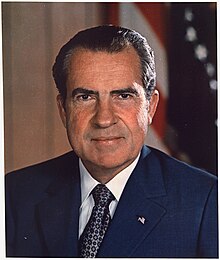
Richard Nixon was the 37th President of United States of America from 1969 to 1974. He also served as U.S Representative and Senator in California for eight years. He ran for president on two separate occasions. His first attempt was a failure as he lost to John F. Kennedy in 1960, but was successful in 1968 against Hurbet Humphrey. Nixon was the one who ended American involvement in the Vietnam War in 1973, allowing American POW's to come home, as well as ending the military draft. Nixon is also the only President in history to resign from office. This action was caused by Watergate scandal.

Richard M. Nixon, ca. 1935 - 1982 - NARA - 530679.jpg
Richard Nixon


The Watergate scandal was a major political involving five thieves breaking into the  Democratic National Committee  headquarters at the Watergate office complex in Washington, D.C. in 1972. These five men were arrested for breaking and entering into the DNC on Saturday, June 17, 1972. When the FBI began investigating, they discovered a connection to the cash found on the burglars and money used by the Committee for the Re-election, which was the organization that was funding Nixon's campaign for his second term. This caused serious controversy that led to the indictment of 69 people, with 25 of them being accused guilty and incarcerated. Many of these suspects were some of Nixon's top administrators. It was also discovered that Nixon held a secret recorder that potentially contained information on the Watergate scandal.  The U.S Supreme Court demanded that Nixon was to release the tapes to investigators. Not long after this order, President Richard Nixon resigned from office on August 9th, 1974.


http://www.history.com/topics/watergate

Writing Research Exercise: monk protests - Lauren Cobb

  During the Vietnam war, south vietnam was under the leadership of Ngo Dinh Diem. Diem’s religious policies heavily favored catholics and persecuted Buddhists. Buddhists appealed to the Diem regime to allow them to fly religious flags, end arbitrary arrests, give compensation and justice to the families of victims in Hue who were killed in a protest against the ban on religious flag, and grant them religious equality. Diem refused, banning demonstrations and attacking and arresting those who disobeyed. On June 11, 1963, a Buddhist monk named Thich Quang Duc finally faced the moment he had been preparing for for several weeks. Letters were sent to the south vietnamese government and the Buddhist community explaining his reasons for what he would do. On this date, Quang Duc sat in the lotus position in the street in downtown Saigon, South Vietnam, while two other monks poured gasoline over him. With a match he was set on fire and burned to death in minutes while onlookers watched in horror. Other buddhist monks and nuns ensured that no one interrupted the demonstration and a few even jumped in front of a fire truck. It was reported that witnesses sobbed, but Quang Duc did not make a single sound or movement as he burned. Although more protests like this followed, this was by far the most well known, and is considered the turning point that led to Diem’s assassination. The demonstration also changed many perspectives on the war even in the United States.


        http://www.oocities.org/tcartz/sacrifice.htm

Research Writing Exercise: Mohammed Ali from Desiree

Muhammad Ali: Draft Evasion

              Mohammed Ali was a famous boxer from Louisville, Kentucky. He is the only fighter to be named world heavyweight champion three times, and he has a 56-5 record. He was originally named Cassius Marcellus Clay Jr. before he converted to Islam in 1964 and changed his name to Muhammad Ali. During the Vietnam war, Ali was inducted on April 28, 1967, but he refused. Since he was Islam, he did not believe in violence. Ali was convicted of draft evasion. When he refused to be inducted into the army, he was immediately stripped of his heavy weight title. He said “I ain’t got no quarrel with those Vietcong” and he asked “Why should they ask me to put on a uniform and go 10,000 miles from home and drop bombs and bullets on brown people in Vietnam while so-called Negro people in Louisville are treated like dogs and denied simple human rights?" Ali was prohibited to box for three years. He was also fined $10,000 and he was sentenced to jail for five years. He avoided prison, and he was able to return to the ring when he fought Jerry Quarry on October 26, 1970. In March of 1971, Ali fought Joe Frazier and lost after fifteen rounds. This was Ali’s first loss of his professional career. This fight was known as “The Fight of the Century”. In June of that same year, Ali’s case was overturned. Ali had to make three separate appeals for them to change his draft status. He believed that he should not be penalized because of his non-violent Islamic faith and his membership of the Nation of Islam.
Ali being escorted from the Armed Forces Examining and Entrance station in Houston

Vietnam Research Exercise by Phillip Wolf

For my research essay of the Vietnam era I chose the topic of The My Lai Massacre. The massacre took place on March 16, 1968; roughly 3 years after the US first sent troops to Vietnam. The Charlie Company of the 11th Infantry Brigade had been sent to My Lai on a search and destroy mission, to remove a Viet Cong battalion that was thought to be in the area. When they arrived in My Lai, the American crew met no opposition, only finding the nearly 700 inhabitants eating breakfast. Despite finding none of the inhabitants to be of fighting age, most children, elderly, or woman the Americans fired upon the civilians. Led by Second Lieutenant William Calley, the crew began killing the civilians mercilessly. Based of off first-hand accounts from US soldiers, a large group of Vietnamese, including women and children, were killed lined up in front of a drainage ditch before being executed. During the massacre, an American helicopter crew spotted the killing, and promptly landed to confront their allies. Many of the ground soldiers claimed they were following orders, others responded that the only help these civilians would get was a "hand grenade". Soon after, the chopper crew was able to convince some soldiers to allow some young civilians to be evacuated, rather than killed. In the end, the soldiers killed somewhere between 347 (reported by the US government) to 504 (reported by Vietnamese government) civilians in the massacre. On top of the killing, the culprits attempted to cover up the killings, reporting that "128 Viet Cong and 22 civilians" were killed in the raid of My Lai. After lengthy investigation, however, it was decided that nearly 30 troops could be charged with war crimes. Despite this, only one, Second Lieutenant William Calley was charged.

Best Source: http://www.digitalhistory.uh.edu/active_learning/explorations/vietnam/vietnam_mylai.cfm

A Vietnamese women being help at gunpoint.

Vietnam Research Exercise by Corey Peck


For my research of the Vietnam era I chose the the topic of The Ho Chi Minh Trail. The Ho Chi Minh Trail was a vast system of roads that stretched from North Vietnam down to South Vietnam (9,940 miles). The purpose of the trail was to help transport resources and supplies to the Vietcong and the North Vietnamese Army. The trail consisted of paths and waterways used for trucks, bicycles and travel by foot. The name Ho Chi Minh came from a North Vietnamese leader who helped form The Democratic Republic of Vietnam just 9 years before the war. It's said to take 6 months to hike the trail by foot but many died from bombings, gunfire and nearly 10% from disease such as malaria. Many camps were along the trail to help treat for injury and illness but hidden underground. Tunnels built by North Vietnamese soldiers would hold thousands of troopers along with food, medical kits, weapons and most deadly communication. The north would send as many as 20,000 soldiers a month but the U.S could not stop because the tunnels and parts of the trail would travel through countries officially stated neutral. Hundreds of tons of war supplies was being moved south through the trail but on November 11, 1968 Operation Commando Hunt was sent into affect by the U.S and allies. At the end of the operation, 3 million tons of bombs were dropped on the country of Laos which held many of the tunnels that aided in war supplies transportation. This operation slowed down supplies and resource transportation but didn't officially end until 1954. Many people view the Ho Chi Minh Trail as being strictly war related but many civilians used its waterways and trails as a way of life. People even say that hiking the trail symbolized aspirations of a generation.


Best Source:
http://www.u-s-history.com/pages/h1875.html


HoCMT.png
This is an image to show the vast area of the trail. 


Vietnam Research Exercise by Paige Riebel

Abbie Hoffman & Anti-War Protests in the U.S.

Abbie Hoffman, born in Worcester, Massachusetts in 1936, was born and raised into a stable family surrounded by both of his parents and two younger siblings. Having been born in the hippie era, Hoffman himself has stated that the 40's was "a great time to grow up in." He took upon his father's humanistic view concerning life and also became an avid student believer in Marxism. He went to Brandeis University where he got his bachelor's in psychology and later went on to the University of California where he got his master's in the subject. 
Hoffman's early protests were associated with SNCC, but he later went on to start his own activist group named the Youth International Party or better known as the "Yippies". Hoffman is best known for his acts in New York where he led his group of people to the New York Stock Exchange. There he and other Yippies threw fake dollar bills intertwined with real ones to the traders who in return ran to the money, trying to grab as much as they possibly could. Hoffman's point to this act was a metaphor to what the stocks were already doing to its people. Through all of Hoffman's protests, he was simply trying to get young people to become more involved in politics. Many believe that Hoffman's actions were beneficial to his passion and that many were persuaded by his creative and controversial doings.
https://en.wikipedia.org/wiki/Abbie_Hoffman

Vietnam Research Writing Exercise By Joe Campanella

     The DMZ or de-militarized zone, is a military term used to describe a combat free zone in war. The DMZ in Vietnam, was the dividing line between the communist North Vietnam, and the democratic South Vietnam. The de-militarized zone was established in 1954, as a byproduct of the Geneva Accords, after the French-Indochina War. When Vietnam split up into two parts after the French-Indochina war, the border between the two countries was the DMZ. The de-militarized zone is located along the Ben Hai River. This boundary zone is also know as "the 17th parallel", because it was located on the 17th degree of latitude.
    
     The DMZ was a well defined border of the two countries at war, that could not be crossed at all times. But the North Vietnamese Army invaded the de-militarized zone, in hope to destroy the South Vietnamese resistance, and gain control over the south. This border between the two countries, provided a main battleground during the war, as well as many important military bases and support stations were located there. Some of the war's most violent and fiercest fighting occurred along this boundary dividing the two countries. The communist controlled North, lead by Ho Chi Minh, invaded the DMZ line, into South Vietnam, in hopes of gaining territory, and defeating South Vietnamese and American troops. There is a major importance of the de-militarized zone in Vietnam, because of it's separation between the two fighting countries, and being the area with the most deadly fighting in the war. This boundary between North and South Vietnam became the defining line between communism and democracy in southeast Asia.